
yokes over-easy
(Free Version)- Sixth Sunday After Pentecost - Zechariah 9:9-12; Romans 7:15-25a; Matthew 11:16-19, 25-30

You can find this week’s readings here.
Our notes this week follow “Track 2” in the Revised Common lectionary. If you are preaching from “Track 1,” check out our notes from three years ago.
Perhaps you are like me. When I prepare sermons, I see faces: sometimes of people in my parish; sometimes those I have known throughout the years. In our readings this week, I think of the burdens they carry, the burdens that we carry.
Some of us carry heavy expectations to be good, or to be excellent, to never make mistakes. Some of us carry the burdens of performance, needing to be seen as “something” in the world. Some of us carry burdens related to safety, making darn sure that we can withstand an economic collapse, the next natural disaster, a hypothetical attack, or a loss of job. Some of us carry burdens related to control, the need to know the next step, or a few steps ahead of whatever we might face. Still, some of us carry a deep concern for tranquility, and would really prefer to never encounter conflict. Even the potential for conflict feels like a burden that we have to bear.
These expectations and desires become burdens when they are all-encompassing. And they impact not only the kinds of people we become, but the families of which we are part, the kind of congregation we are becoming, the kind of nation we want to live in.
Of course, there is nothing wrong with excellence, performance, safety, control, or tranquility. It is the pursuit of these as a final goal, their achievement a definition of “the good life,” or the underlying fear that is the problem.
Some of our burdens are inherited. We were taught growing up what it means to be a “good girl” or a “good boy,” which is supposed to translate in being a good citizen, good wife, good husband, or good friend. Many of our burdens are religious in nature. We are told that there are certain things we can do or be which will make us more acceptable to God or to the religious community.
Still, some burdens are systemic. Our economic, political, and educational systems erect structures which create more burdens for those on the underside of power than those who have wealth and privilege. For those who these carry burdens and others, those who have been straining to keep up with them and those who have fallen down; for the trampled, shamed, and name-called: the gospel is good news.
In our Old Testament reading (Track 2, Zechariah 9:9-12), the prophet envisions a new king who will be unlike any king the people have ever experienced before. This king is righteous, and also victorious. But, then, the hearer is invited to take a sharp turn in their expectations for this king. Rather than a warhorse, he will ride on a donkey, and a young one at that! This makes sense because, the prophet says, God will take away the warhorses and the chariots. Israel is being invited to imagine a new world altogether, where the ways they have been taught to solve their problems, the burdens they have carried are robbed of the power they have over them. The end result of such a world is liberation, a fortress of hope.
What might it mean if we lived in such a world? Where the false and destructive ways we have been taught to solve our problems would be rendered helpless before the liberating God. We no longer need to topple others on our way to the top. We no longer need to tear down our fellow image bearers to prove our point. We no longer need to exclude others because of who they are so that we can feel better about who we are. We no longer need to reject others to protect our own curated feeling of safety. The inauguration of this new leader marks out our freedom from these burdens.
Our epistle reading (Romans 7:15-25a) is a tongue twister. Paul goes on for sentences about the ways in which he wants to do good, but can’t seem to; and the ways in which he doesn’t want to do what is wrong, but keeps doing it. It is likely that the “I” is a rhetorical device. He is not speaking of himself in the present moment, but those who try to find salvation from sin and death by obeying the law. The “I” may be Israel, or it may be anyone who is attempting this futile endeavor.
The law is good, and it is good to obey it. Likewise, it is good to be God’s chosen people. Yet, those who try to find salvation in the law are frustrated because it only reveals how broken they really are; the evil which is working against them. It almost seems like there are two laws at work, and one is waging war! Who can rescue from such a burden? Paul immediately gives us the answer: “Thanks be to God through Jesus Christ our Lord!” Rescue comes only from him.
In our gospel reading (Matthew 11:16-19, 25-30), Jesus is telling John the Baptist’s disciples how the people have rejected the kingdom of God in rejecting both he and John the Baptist. “This generation” can’t seem to make up their mind. John is solemn and serious, calling the people to repentance, and faithful fasting. Yet, they call him a demon. By contrast, Jesus has come liberating, celebrating, throwing a party for those who have been cast aside, rejoicing in what God is doing. Yet, they say that he is a drunkard, a friend of tax collectors and sinners (words describing a “rebellious son” in Deuteronomy, who was to be stoned to death!).
The good news is that it is not Jesus’ opponents who get to say what God is like. Only Jesus can do that. The truth is that those who think they are so wise and intelligent as to know God are blind to what he is doing. It is the “little ones” who know what’s up because it has been revealed to them.
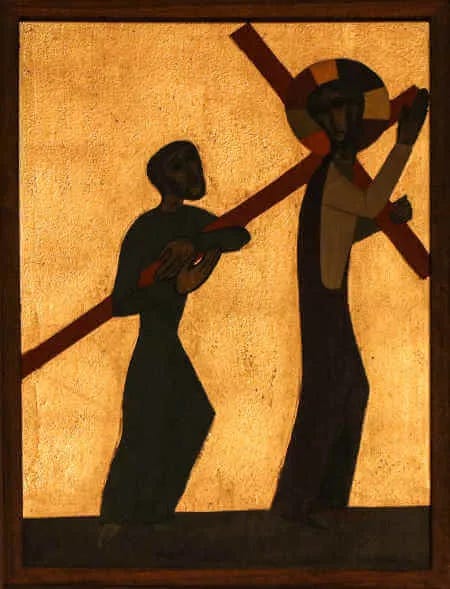
Those who are playing by the rules of the world as it is will react to the way of the kingdom and love of God with violent rejection, because it does not make sense in such a world. A world where burdens are lifted and yokes are shared…can that actually exist? Those who are weary and burdened by the world as it is, by its expectations, by its calls to keep up, will find an easier yoke. It is not easier because it makes less demands, but because of who we are yoked to. He is the humble one. He is not like those who dominate, who lead by way of slaughter. He is gentle and humble in heart. We can trust him with our burdens…Our hearts can rest here. Thanks be to God.
Untill the trinitarians faithfully address that heresy, untill those waiting on the return of Jesus address that heresy, none of any of this “holy spirit”, faith & orthodoxy matters. None of the everyday theologies nor doctrines matter in the slightest…….
The gospel is completely absent of almost every so called christain church, So delusional, Its basicaly all just inumerable & aimless groups all captured into cults of their own echo chambers “faithfully” upholding the most damndable heresies imaginable.
…. You can’t love that which you deny & denounce.
P.S……. NOT A SUPER “CONCERN” BUT OF MUCH USEFUL INTREST ……..THE "EASTER" & CRUCIFIXTION-PASSOVER & RESURECTION = SUMMER NOT SPRING. ASCENSION WAS TOWARD FALL TIME.
https://allendaves.substack.com/p/palm-sunday-easter-and-resurection-3d9?utm_source=share&utm_medium=android&r=1xhldx